
Another overnight trip to the Middle Rhein Valley:
Bacharach, Oberwesel, Sankt Goar, and Boppard
June 2025
The Rhein (Rhine in English) Valley is in a beautiful part of Germany and includes steep terraced hillsides covered in Riesling vineyards, quaint towns with cobbled streets and half-timbered buildings, lush green forests, and so many hilltops with amazing old castles and fortresses. This area is also popular for river cruises (be prepared for possible crowds), camping (many options along the river), hiking, and cycling (watch for bikes when driving!).
Our friend Heidi was in Germany visiting us from the US. We wanted to take her on a one-night road trip. What better place than the Middle Rhein Valley?
Mike and I spent a weekend in Rüdesheim am Rhein (Middle Rhein Valley), as well as Cochem, and Eltz several weeks earlier and loved it. So we were eager to go back and see more of this scenic region. We picked some new towns that we hadn’t been to yet – and we were off!
The Rhine Valley or Middle Rhine (German: Mittelrhein) is the most famous section of the Rhine, running between the cities of Bingen (near Mainz) and Bonn in Germany and spanning the states of North Rhine-Westphalia, Rhineland-Palatinate and Hesse. If you love seeing old castles, this is a great place to go! This area, specifically the UNESCO World Heritage Site between Bingen and Koblenz, has around 40 castles, palaces, and fortresses, some of which are ruins. This makes it one of the regions with the most castles in the world!
We started and ended our journey in Heidelberg, but much of the drive was along the beautiful Rhein River. The river twists and turns through beautiful countryside, with a castle or fortress around almost every corner.
Our weekend roundtrip covered 321 km (199 miles) and took 4 hours, 40 minutes of driving.

The route we chose had Bacharach as our first stop. With castles everywhere, it’s hard not to get distracted – but we gazed at them, took some photos, and continued on our way.
On our way to Bacharach, we passed Burg Rheinstein. This castle is the epitome of Prussian Rhine romanticism! It is a reconstructed hillside castle on the steep slope of the Bingen Forestand and was built between 1306 and 1320. This castle is open daily from March 15 to November 1 and on Saturdays and Sundays during the winter months.

We also passed Burg Reichenstein. This large castle is an example of a reconstructed castle in the neo-Gothic style. Its original builder is unknown, but the original building dates from the first half of the 13th century. Burg Reichenstein now serves as a hotel and event space.

Bacharach
Our first stop was the adorable town of Bacharach – a quintessential Rhein Valley town with its cobbled streets, half-timbered houses, vineyards, castle, and more. It’s like something out of a fairy tale! It was a great place to start our trip and introduce Heidi to the region.
We started by wandering up the hill to see Bacharach’s castle. On the way, we passed beautiful half-timbered buildings.


As we started our climb up the hill, we passed St Peter’s Church. The late Romanesque gallery basilica was built around 1230 and has since been a dominant feature of the medieval townscape of Bacharach. It’s red/orange coloring was similar to others built around the same time in this region.


Just above St Peter’s Church was the Wernerkappelle or Werner Chapel. Werner of Oberwesel (1271-1287) was a 16-year old boy whose unexplained death was blamed on the Jews, leading to revenge killings of Jews across Europe.
He was venerated as a Saint and this monument was built in his honor and became a popular pilgrimage site. In 1963, he was stripped of his sainthood.
The French blew up the castle above the chapel in 1689, sending rocks down that collapsed the roof of Werner Chapel. The remains of this chapel (built from 1289 to 1430) is a unique example of German high gothic architecture.


From the Chapel to the castle at the top of the hill, we followed steep, tree covered paths that would open up occasionally to great views of the Rhein River and the vineyards of Bacharach.


At the top of the hill, we reached Burg Stahleck. This castle is a 12th-century fortified castle on a hill approximately 160 metres (520 ft) above sea level, with a commanding view of the Lorelei valley. Its name means “impregnable castle on a crag.” It was destroyed (blown up) by French troops in 1689 and remained in ruins for years. In 1925, Stahleck Castle was rebuilt based on a historical model. Today, it serves as the world-famous Bacharach Youth Hostel. Can you imagine staying in a hostel in a castle???


After wandering back down the hill, we explored some more of Bacharach.


We came across St. Joseph’s Chapel, a beautiful mid-18th century church that blends inconspicuously into a restored building complex of a former Catholic grammar school. You’d never know it was a church from the outside, but I happened to notice a sign on the wall indicating it was.

We headed back across the highway to our car in a parking lot on the Rhein River. From the waterfront, we could see Burg Gutenfels across the river. Gutenfels Castle was built around 1200. It was renovated and now serves as a hotel with five rooms, as well as a library with fireplace and small sauna area.

And just below the Gutenfels Castle on an island in the River Rhein was Pfalzgrafenstein Castle. Also known as Pfalz, this very cool castle on a tiny island was originally built in 1327. It served as a customs post on the Rhein River and is only accessible via the passenger ferry from Kaub.

Oberwesel
We left Bacharach and drove 4 miles up the road to our next stop: Oberwesel. As many of the middle Rhein region’s towns did, Oberwesel probably had its beginnings as a Celtic settlement.

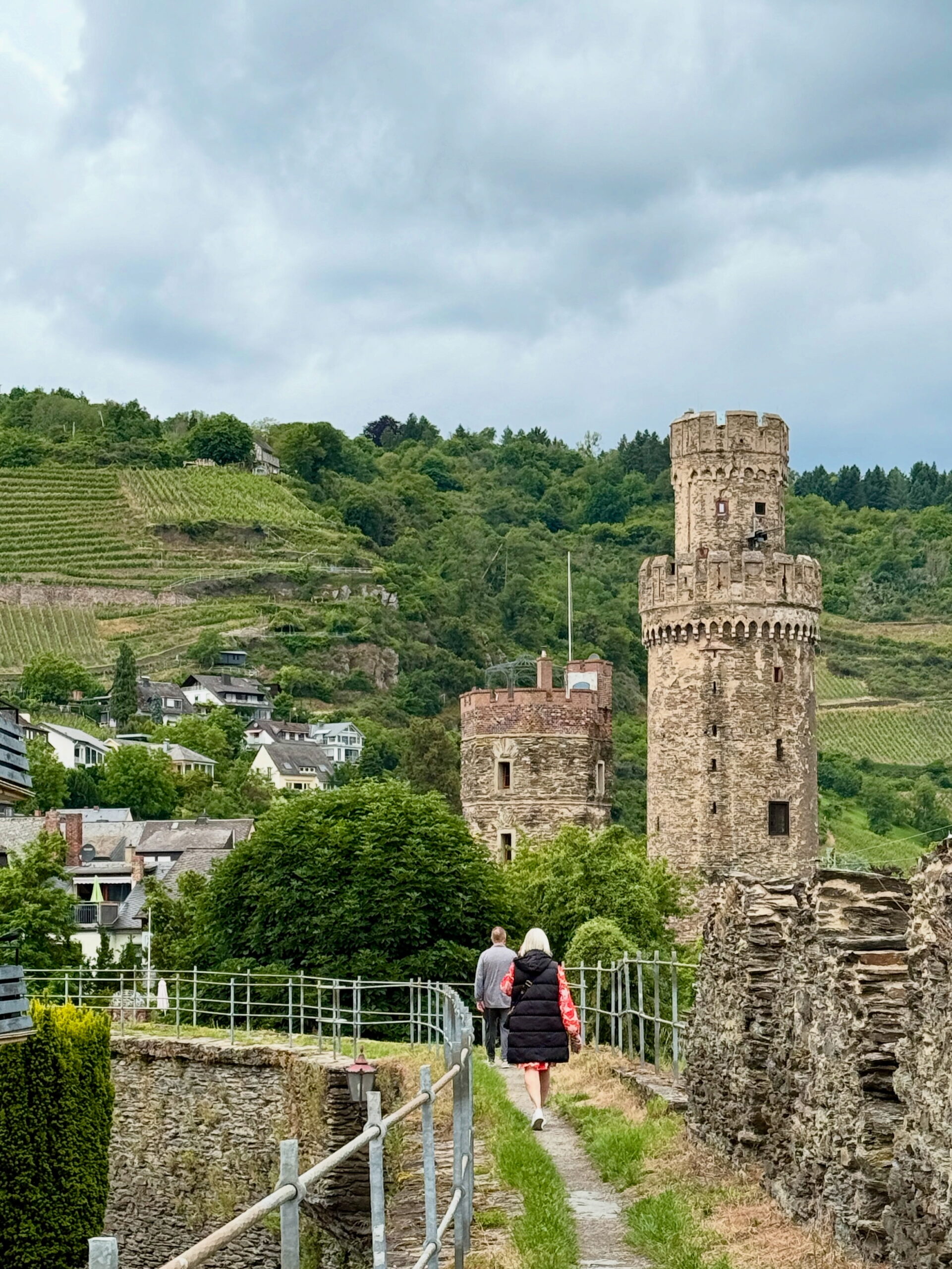
Anyone visiting Oberwesel for the first time will understand where the nickname “town of towers and wine” comes from. With its 16 towers, the historic town wall in Oberwesel is the oldest, largest and best-preserved city fortification on the Middle Rhein.
So that’s where we started – walking the historic town wall!


Some other things Oberwesel is known for (that we did not visit) include:
Schonburg Castle – A castle that towers above Oberwesel that we did not visit as it is now a hotel and restaurant.


St Martin’s Church – An historic church with impressive architecture and valuable artwork. While we did not go inside, we could see it towering above town from the town wall.

Oberwesel Wine Festival – The annual wine festival in town that was not going on when we were there.
Sankt Goar
From Oberwesel, we drove another 5 miles up the Rhein to Sankt Goar, where we were staying for the night.
We arrived at our hotel – The Weinhotel Landsknecht. The people working there were super friendly and the check in process was easy. Our room was a basic hotel room (of decent size by European standards) and had a view of the river and the castle across the river.


The castle we could see from our room was Burg Maus. Castle “Mouse” was established in 1356 and is in the town of Sankt Goarshausen. This castle is privately owned and can only be viewed from the outside.
We left our bags at the hotel and drove into the Sankt Goar old town. We were hungry so we walked through the town and along the waterfront looking for a place to eat. We selected Bistro Café Goar, which was quite good. I had a traditional flammkuchen (like a flatbread pizza) and it was very tasty!


Our table was outside in front of the restaurant, with a view of the river and Katz Castle. When I say there are castles, castles, and more castles in the Middle Rhein, I am not kidding! They are everywhere and they are beautiful. The photos don’t quite do justice to the experience of seeing them.

After lunch, we hiked up the hill in Sankt Goar to see Rheinfels Castle and do the self-guided tour. This castle was built in 1245 to protect the customs of St Goar. Within a short time, it expanded into one of the strongest castles in the Middle Rhine. In 1479, the castle fell to Hessian landgraves. At this time, it was rebuilt into a Renaissance castle and extended to become one of the strongest fortresses in Germany. In 1692, Rheinfels Castle was the only fortress on the left bank to be successfully defended against Louis XIV’s troops. In 1794, it was surrendered to the French army and eventually blown up in 1796/97.
This castle is well worth visiting and can be accessed for a self-guided tour for just 6 euros.


On the way back to the car, we made a special stop at a clock store that we’d read about in researching Sankt Goar. Montag Steins & Clock is a shop known for its cuckoo clocks and beer steins – and they had plenty of each! They also feature what is claimed to be the world’s largest handmade, hanging cuckoo clock. While the cuckoo clock is what we stopped to see, it was not as exciting as the description made it sound.

From there, we headed back to the hotel to enjoy a relaxing evening of wine tasting and dinner.
The Weinhotel Lanksknecht had its own winery – Weingut Lorenz. Near the hotel lobby, there was a small area with a nice display of their wines. We were seated and helped by a guy who knew a great deal about the wine.
We sat on the hotel’s lovely indoor / outdoor terrace right on the river, with views of the vineyards and castle on the left bank. The room had glass windows and ceiling that could be opened and closed based on the weather.

We did a wine tasting that included 4 of the Lorenz wines – all grown up the road in Boppard’s Hamm vineyard. We tasted a 2021 Pinot Noir, a 2023 Pinot Gris, a 2020 dry Riesling, and a 2023 off-dry Riesling. While nothing like Oregon or California wines, all of their wines were quite good and we ended up purchasing 2 reds and 2 whites to bring home with us. As Americans, we tend to have a negative reaction to Rieslings as many of the ones in the US are very sweet. But Germany makes some great dry Rieslings that we are enjoying getting to know more about them while living here.


After the wine tasting, we’d made dinner reservations at the hotel restaurant – which had gotten great reviews online. And we couldn’t agree more with the reviews! The restaurant was lovely, with nice decor and big windows with views of the river. The food was amazing! And the service was fantastic.
We started with bread and an amuse bouche of feta and tomato salad. It was white asparagus season so I ordered white asparagus that came with potatoes and veal. Heidi had a goat cheese salad. Mike had mushroom schnitzel. Great presentation and so yummy!


After the wonderful dinner, great conversation, and a good night’s sleep the night before, we started the next morning with the hotel breakfast before heading to our next destination.
The breakfast was a large European breakfast buffet that included boiled eggs, bacon, sausage, potatoes, juices, coffee, tea, cereals, fruit, yogurt, baked goods, vegetables, meats, and cheeses. It was a lovely assortment of options and you can get a room rate that includes the breakfast or purchase separately.


Boppard
The next destination on our list was Boppard, which was 9.5 miles up the Rhein River. Its location on a prominent bend in the Rhein gives it strategic importance and natural beauty. This stretch of the Rhine, often referred to as the Rhine Gorge, is steeped in history and has inspired centuries of art, folklore and tourism (Boppard is one of the stops for some cruise ships so it can get busy sometimes).
I’d read about the ski lift to the top of the hill where there was an amazing view of the bend in the Rhein River so that’s where we went first. And it did not disappoint!
We arrived at the Sesselbahn Boppard (Boppard ski lift) just as it was opening – which was the perfect timing to avoid any crowds.

This chairlift takes 20 minutes to ascend to the top of the hill and offers gorgeous, picturesque views of the bend in the Rhein. A maximum of 500 people can be transported per hour in 80 chairs. While rising 761 feet in altitude, you get views of vineyards, forest, and river. I’m not a big fan of heights so had to challenge that fear on the chairlift ride!
Once at the top, a short walk leads you to a restaurant and look out point. We enjoyed some hot chocolate while taking in the scenery… And the views were amazing!!


And the trip back down the chairlift to the valley offers great views in the other direction.


The Sesselbahn Boppard cable car, built in 1954, runs daily from the end of March to the end of October. It’s a “must see” when in this part of the Rhein Valley.
From the bottom of the ski lift, we walked along the scenic riverfront promenade to the old town and saw:
St Severus Basilica – In the center of Boppard on the market square stands the St. Severus Church, built in the late Romanesque style. It is impressive from the inside and the outside. This large white church, which dates back to the 13th century, dominates the small town of Boppard.


Romer-Kastell – In the midst of the town are the ruins of an old Roman fort. Boppard was one of the most important Roman settlements on the Middle Rhine. In the middle of the 4th century, they built a fortification which they named BODOBRICA which later became BOPPARD, the present-day name. When times became too troublesome for the Romans, they left the Rhein and the fort became the core of the present-day town. The remains of the Roman Fort surround the town centre and are the best example of a Roman fort in Germany.


The Electoral Castle – The castle in Boppard is one of the important fortified complexes of the Middle Rhine. It was built by Balduin the archbishop of Trier as a stronghold after he had conquered the town in 1327. The tower with pouring holes belonged to the original building, the four wings and the yard date from the 17th Century.

From there, our plan was to drive back to Heidelberg on the other side (right bank) of the river. We had planned to stop in Rudesheim am Rhein for lunch but, when we arrived, it was so busy we couldn’t not find parking. So we kept driving and, instead, we stopped in Eltville for lunch and then headed back home to Heidelberg.
This was another great 2-day adventure! And fun to share it with Heidi. The Middle Rhein Valley is so beautiful and romantic. You can’t beat the picturesque scenery, romantic allure, and historical significance. The twisting and turning Rhine River, the cobbled villages with half-timbered houses, the vineyards on every slope, and castles on every hilltop make it a dream come true!
Thanks for sharing this amazing journey!
🙂 Miss you!